

Imagine this: A patient in your area has a toothache. They pull out their phone, search for “emergency dentist near me,” and pick the first practice that appears. Was it yours?
If not, you’re not alone, but you’re also losing patients to competitors who invested in SEO.
The good news? It’s never too late to start. This guide shows you exactly how to get started with SEO for dentists in a few simple steps.
What Is Dental SEO and Why Is It Important?
Dental SEO is the practice of optimizing your website and online presence to rank higher in search engine results for dental-related queries. Simply, it ensures you appear for terms like “dentist near me,” “teeth whitening [city],” or “emergency dentist open now.”
Why Dental SEO Matters Now More Than Ever
- Patients search Google before choosing a dentist.
- Local rankings help nearby patients find you.
- Top-ranking practices earn more trust.
- Organic traffic delivers cost-effective, long-term results.
- SEO lets you showcase your services, reviews, and unique strengths.
Now, let’s dive into how to get started with SEO for dentists and dental clinics in just 7 actionable steps.
You Can Learn Also: SEO Practices to Enhance Your Dental Marketing
How to Get Started with SEO for Dentists In 7 Steps
Here are 7 actionable steps to help you launch your dental SEO strategy and start attracting more patients online. Follow these in order, and you’ll build a solid foundation for long-term success.
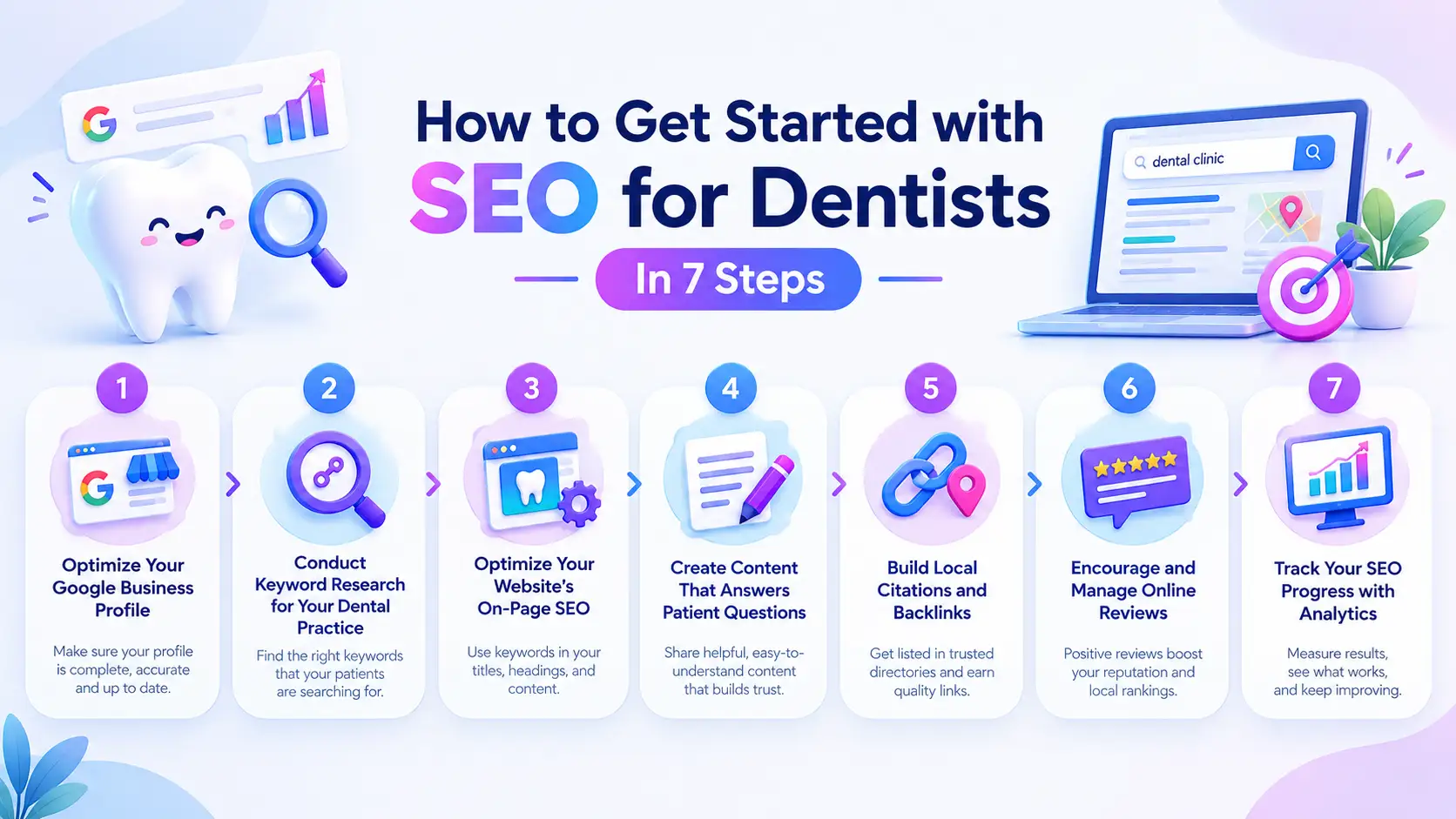
This is how to get started with SEO for dentists – Let’s go:
Step 1: Optimize Your Google Business Profile
Your Google Business Profile (formerly Google My Business) is the most important local SEO tool for your dental practice, as It appears when someone searches for your practice or looks for dentists in your area.
How to Optimize Your Google Business Profile:
- Complete every section of your profile.
- Add your correct business name, address, and phone number.
- Choose ‘Dentist’ as your primary category and add relevant secondary categories, such as ‘Cosmetic Dentist’ or ‘Pediatric Dentist’
- Write a clear description that highlights what makes your practice unique.
- Upload high-quality images of your clinic, team, equipment, and smiling patients.
- Keep your opening hours updated.
- List your dental services.
- Encourage patients to leave reviews.
- Respond to patient reviews professionally.
- Regularly publish posts and updates.
- Keep all information accurate and consistent.
Think of your Google Business Profile as your online welcome mat. It’s where most patients find you first, so make it shine before diving into the rest of your SEO strategy.
Step 2: Conduct Keyword Research for Your Dental Practice
Keywords are simply the words and phrases people type into Google when looking for a dentist or a specific dental treatment. Examples include “dentist near me,” “dental implants,” or “emergency dentist.”
Your job is to find out which keywords are most relevant to your practice and your local area. Once you know them, you can use them naturally on your website, in blog posts, and in your Google Business Profile.
This helps your practice show up when people are searching for the treatments you offer.
Discover: How to Do Dental Keyword Research
Step 3: Optimize Your Website’s On-Page SEO
On-page SEO is about making each page on your site better for both visitors and search engines. This includes your homepage, service pages, blog posts, location pages, and contact page.
Check These On Every Page:
- Title Tags: Keyword + location at the start. Max 60 characters.
- Meta Descriptions: Clear summary with keywords. Max 160 characters.
- Headers: One H1 per page, with H2s and H3s for structure.
- URLs: Short and descriptive (e.g., /services/implants).
- Image Alt Text: Describe images with keywords.
- Internal Links: Connect to other relevant pages.
- Content: Helpful, detailed, and patient-focused.
- Mobile: Fast, responsive design.
What Every Service Page Needs:
- Clear description of the treatment
- Benefits and what patients can expect
- Cost information or financing options
- Before-and-after photos
- Patient testimonials
- A strong call-to-action (e.g., “Book Now” or “Schedule a Consultation”)
- Location-specific details
Remember:
Never target the same keyword on multiple pages. Each page should focus on a unique primary keyword to avoid competing with your own content.
Step 4: Create Content That Answers Patient Questions
Good content does two things: it helps patients find answers and shows search engines that you know your stuff.
Keep These Tips In Mind:
- Think about the top 10 questions you hear in your practice.
- Write for patients first, search engines second.
- Write clear, simple answers that reassure and inform.
- Use simple, reassuring language that patients can easily understand.
- Format for readability with short paragraphs, bullet points, and clear headings.
- Include relevant keywords naturally without forcing them.
- Add internal links to service pages and other relevant content.
- Refresh old content regularly to keep it accurate and up-to-date.
When you write with your patients in mind, everyone wins – especially your SEO.
Step 5: Build Local Citations and Backlinks
Off-page SEO is about building your practice’s reputation across the web. This happens through citations and backlinks (They help build trust with Google and patients).
1] What Are Local Citations?
Citations are mentions of your Name, Address, and Phone Number on other websites (They prove your practice is real).
Where To Build Citations:
- Google Business Profile
- Bing Places
- Facebook Business Page
- Yelp
- Healthgrades, Vitals, Zocdoc, WebMD
- Local Chamber of Commerce
- Better Business Bureau
- Local business directories
- Dental association listings
2] What Are Backlinks?
Backlinks are links from other websites to yours. They act like votes of trust that tell Google your content is valuable.
How To Build High-Quality Backlinks:
- Partner with local businesses and exchange links
- Join your Chamber of Commerce for a directory listing
- Sponsor local events – they often link to sponsors
- Write guest posts for health or dental blogs
- Get featured in local media or newspapers
- Create shareable content like infographics or videos
Pro Tip:
Quality matters more than quantity. One link from a trusted local site is better than many from low-quality directories.
Step 6: Encourage and Manage Online Reviews
Online reviews are one of the best ways to show new patients what you’re all about, as they send positive signals to search engines about your practice’s credibility and quality.
Don’t be shy – ask your satisfied patients to share their experience online. A simple email or text with a review link goes a long way.
And remember, responding to every review (whether it’s 5 stars or 3) shows that you genuinely care about your patients’ feedback and are always looking to improve.
Step 7: Tracking Your SEO Progress with Analytics
You can’t improve what you don’t measure. Set up Google Analytics and Google Search Console to monitor key metrics like:
- Website visitors
- Where your traffic comes from
- How many patients book appointments online
- Which keywords bring the most visitors
Review these metrics regularly to understand what’s driving results and where to invest your time and budget moving forward.
When to Consider Working with a Dental Marketing Agency
SEO works – but it takes time, knowledge, and consistency. If you’re too busy treating patients to stay on top of it, an agency can make all the difference.
Ready to learn how to get started with SEO for dentists? Here’s what we can do for you:
- Conduct comprehensive keyword research and competitor analysis
- Optimize your Google Business Profile and local citations
- Improve your website’s on-page SEO and user experience
- Create high-quality content that attracts and converts patients
- Build authoritative backlinks to boost your site’s credibility
- Manage online reviews and reputation
- Track and report on performance monthly
- Provide strategic guidance and ongoing optimization
At Ebakr Dental Marketing Agency, we combine technical expertise with deep industry knowledge to help dental practices achieve sustainable growth.
Let us carry the marketing load so you can carry on doing what you do best!
Conclusion
SEO is a journey, not a quick fix. Just Follow these 7 steps, stay consistent, and you’ll see your practice grow over time.
Start with your Google Business Profile, research the right keywords, create helpful content, and track your results. It’s a long-term game, but every small step brings you closer to more patients.
That’s how to get started with SEO for dentists – simple, steady, and effective.
And if you need expert help along the way, our dental SEO services are here to support you every step of the journey.
Frequently Asked Questions
Have questions about dental SEO? Here are some simple answers to help you understand how SEO can improve your online visibility and attract more patients.
How Long Does Dental SEO Take To Show Results?
Usually 3 to 6 months. Some changes show results in weeks. SEO takes time – be patient.
Should I Focus on Google Business Profile or My Website?
Both. Google Business Profile helps people find you locally. Your website gives them more details. They work together.
Is SEO Worth It For Dentists?
Yes. It brings patients over time without paying for ads every month. Most practices get a good return on investment.
What’s The Difference Between Local SEO and General SEO?
Local SEO targets patients near you. General SEO targets everyone. For dentists, local SEO is more important.
What Is The Most Important SEO Factor For Dentists?
Your Google Business Profile, good reviews, and correct contact details across the web.
What Should I Do If I Get a Negative Review?
Reply calmly. Apologize, listen, and offer to talk offline. A thoughtful response shows future patients that you care and are committed to improving.