
Introduction: Why Local SEO is Your Dental Practice’s Lifeline
In today’s digital-first world, your dental practice’s growth is no longer confined to word-of-mouth referrals and local flyers. The modern patient journey begins online, typically with a simple search query like “dentist near me” or “emergency dentist in [Your City].” This is where local Search Engine Optimization (SEO) becomes your most powerful tool for patient acquisition. For dentists across the U.S., a strong online presence isn’t just an advantage; it’s a fundamental requirement for survival and success in an increasingly competitive market. Mastering local search is the key to filling your appointment book with high-intent patients actively seeking your services.
The Fierce Local Search Landscape for U.S. Dentists
The dental services market is expanding, with projections showing it could reach $731.45 billion by 2029. This growth translates to more competition in every locality. When a potential patient searches for a dentist, Google presents them with a “Local Pack” map and a list of top-ranking practices. If your dental practice isn’t visible in these critical search results, you are effectively invisible to the majority of potential new patients. In fact, research shows 87% of consumers use Google when researching local businesses, making your visibility on this platform non-negotiable.
What is Local SEO for Dental Practices?
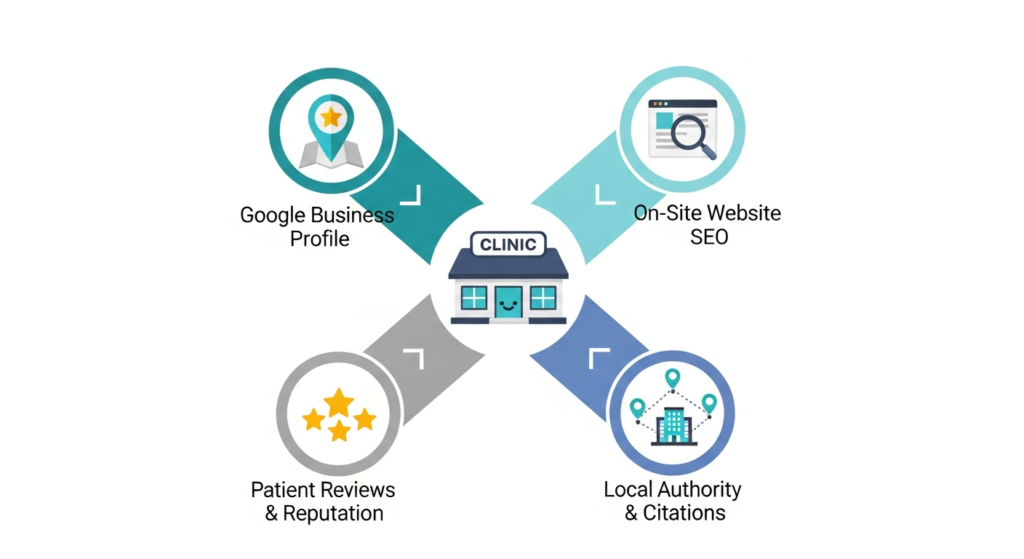
Local SEO is a specialized branch of Search Engine Optimization focused on improving your practice’s visibility in local search results. Unlike general SEO, which targets a national or global audience, local SEO targets patients within a specific geographic area—your community. It involves a strategic blend of optimizing your Google Business Profile, refining your website, managing patient reviews, and building local authority. The goal is simple: ensure that when a patient in your area searches for dental services, your practice appears prominently, signaling to both search engines and users that you are a relevant, trustworthy, and proximate choice.
Master Your Google Business Profile (GBP): The Cornerstone of Local Visibility
Your Google Business Profile (GBP) is arguably the single most important asset in your local SEO arsenal. It’s the information-rich panel that appears in Google search results and on Google Maps, providing patients with a snapshot of your practice: your location, hours, services, photos, and reviews. A well-optimized GBP is the foundation upon which your local search dominance is built.
Claiming and Verifying Your Google Business Profile
The first step is to claim and verify your listing. Go to google.com/business and search for your practice name and address. If a profile exists, you’ll need to claim it. If not, you can create one from scratch. Google will then verify your ownership, typically by mailing a postcard with a verification code to your practice’s physical address. This verification step is crucial as it proves to Google that your practice is legitimate and located where you say it is.
Comprehensive Optimization of Your GBP for Dentists
Once verified, you must meticulously complete every section of your profile.
- NAP (Name, Address, Phone): Ensure this information is 100% accurate and consistent with your website and other online directories.
- Categories: Select “Dentist” or “Dental Clinic” as your primary category, then add relevant secondary categories like “Cosmetic Dentist,” “Orthodontist,” or “Pediatric Dentist.”
- Services: List all the services you offer, from routine cleanings and fillings to specialized procedures like implants, veneers, and root canals. Use relevant keywords here.
- Business Description: Write a compelling, keyword-rich description of your dental practice, highlighting what makes you unique.
- Photos and Videos: Upload high-quality images of your office (interior and exterior), your team, and your technology. A virtual tour can be particularly effective.
- Attributes: Add relevant attributes, such as “Accepts new patients” and accessibility information.
Actively Managing Your GBP for Superior Performance
Your GBP is not a “set it and forget it” tool. Ongoing management signals to Google that your practice is active and engaged.
- Google Posts: Regularly share updates, special offers, blog posts, or practice news using this feature.
- Q&A Feature: Proactively populate this section by asking and answering common patient questions. Monitor and promptly answer any questions submitted by users.
- Reviews: Encourage patients to leave reviews and respond to every single one, both positive and negative.
Your Dental Website: The Ultimate Patient Resource & SEO Powerhouse
While your GBP is your digital handshake, your website is the comprehensive digital hub for your practice. It’s where you convert searchers into patients by providing detailed information, showcasing your expertise, and offering a seamless user experience. A well-structured website is a powerful SEO tool that reinforces the signals you send through your GBP.
On-Page SEO Essentials for Dental Websites
On-page SEO involves optimizing the content and HTML source code of your website’s pages.
- Title Tags and Meta Descriptions: Each page should have a unique title tag and meta description that includes your target keywords and location (e.g., “Cosmetic Dentist in Seattle | [Practice Name]”).
- Service Pages: Create dedicated pages for each of your core services (e.g., Dental Implants, Teeth Whitening, Invisalign). These pages allow you to rank for specific, high-intent keywords.
- Location-Specific Content: Integrate your city and neighborhood names naturally throughout your website content, especially on the homepage and contact page.
- Header Tags (H1, H2, H3): Use header tags to structure your content logically and incorporate keywords, making it easier for both users and search engines to read.
Technical SEO for a Flawless User Experience & Search Engine Visibility
Technical SEO ensures that search engines can crawl and index your website effectively.
- Mobile-Friendliness: Your website must be responsive and easy to navigate on all devices. A significant portion of local searches happen on mobile; in fact, 88% of consumers who do a local mobile search visit or call within a day.
- Page Speed: A slow website frustrates users and hurts rankings. Aim for fast loading times. Data indicates that dental websites loading under 2 seconds can see significantly higher conversion rates.
- Schema Markup: Implement local business schema markup on your website. This is a type of code that helps search engines understand crucial information about your practice, such as your address, phone number, hours, and the services you provide. Use specific types like Dentist and MedicalProcedure for greater clarity.
Optimizing Your Website for Patient Conversion
Getting traffic to your website is only half the battle. You must convert those visitors into appointments.
- Clear Calls-to-Action (CTAs): Use prominent buttons like “Request an Appointment” or “Call Us Today.”
- Visible Contact Information: Your phone number should be clickable and visible on every page, preferably in the header.
- Online Booking: Integrate an easy-to-use online scheduling tool to reduce friction for new patients.
Local Keyword Strategy: Attracting Patients with Precision
A successful local SEO strategy is built on targeting the right keywords. You need to understand the exact phrases potential patients are typing into Google when they need a dentist in your area. This allows you to tailor your online presence to meet their specific needs.
Identifying Your Target Local Keywords
Local keywords typically combine a service with a location. They can be broad or highly specific.
- Geo-Modifiers: These are keywords like “[service] in [city]” (e.g., “sedation dentistry in Austin”) or “[service] near me.”
- Neighborhood Keywords: For larger cities, target specific neighborhoods (e.g., “dentist in SoHo NYC”).
- Intent-Based Keywords: Consider the user’s intent. “Emergency dentist” implies urgency, while “best cosmetic dentist” suggests a search for quality and reviews.
Tools and Techniques for Effective Keyword Research
While you can brainstorm many keywords, using tools can uncover opportunities you might miss. Tools like Google Keyword Planner, Ahrefs, and Semrush can provide data on search volume and competition. You can also analyze your competitors’ websites to see what local keywords they are targeting in their title tags and content.
Integrating Local Keywords Naturally into Your Content
Once you have your list of keywords, you must integrate them seamlessly into your digital assets. This includes your GBP service descriptions, your website’s service and location pages, blog posts, title tags, and meta descriptions. The key is to write for humans first and search engines second. Avoid “keyword stuffing,” which is an outdated practice that can harm your rankings.
The Power of Online Reviews and Reputation Management for Dentists
In the healthcare field, trust is paramount. Online reviews have become the modern-day equivalent of a personal recommendation, and they are a massive factor in both local search rankings and a patient’s decision-making process.
Why Patient Reviews Are Critical for Your Dental Practice
Positive reviews build social proof and signal to Google that your practice is a trusted local authority. A steady stream of recent, positive feedback can significantly boost your visibility in the Local Pack. The influence of reviews is undeniable, as 71% of people search online when looking for a dentist. Furthermore, recency matters; a study found that 76% of patients won’t consider a practice if its reviews are more than three months old.
Strategies for Generating More Positive Customer Reviews
The best way to get reviews is to ask for them. Implement a simple, consistent process.
- Post-Appointment Emails/Texts: Send a follow-up message after a visit with a direct link to your Google Business Profile review page.
- In-Office Signage: Use QR codes in your waiting room or at checkout that lead directly to your review profiles.
- Personal Request: The most effective method is often a simple, personal request from the dentist or hygienist at the end of a positive appointment.
Effectively Managing and Responding to All Online Reviews
Engaging with reviews shows that you value patient feedback.
- Respond Promptly: Aim to reply to all reviews within 24-48 hours.
- Thank Positive Reviewers: Acknowledge their kind words and reinforce the positive experience.
- Address Negative Reviews Professionally: Respond calmly and professionally to negative feedback. Acknowledge the patient’s concerns, take the conversation offline to resolve the issue, and demonstrate your commitment to patient satisfaction. Never argue online.
Building Local Authority: Citations, Backlinks & NAP Consistency
Local authority is a measure of how prominent and trustworthy search engines perceive your practice to be within your geographic area. Three key components build this authority: NAP consistency, local citations, and high-quality backlinks.
The Indispensable Role of Consistent NAP
Your practice’s Name, Address, and Phone number (NAP) must be identical across your entire online presence. This includes your website, GBP, social media profiles, and all directory listings. Inconsistencies can confuse search engines and erode their trust in your location data, which can negatively impact your local rankings.
Local Citations: Getting Your Dental Practice Listed Everywhere That Matters
A local citation is any online mention of your practice’s NAP. These act as verifications of your business’s existence and location. Ensure your dental practice is listed accurately on major data aggregators and relevant online directories such as Yelp, Healthgrades, and local chamber of commerce websites.
Earning High-Quality Local Backlinks
A backlink is a link from another website to yours. Search engines view backlinks as votes of confidence. Earning links from other reputable, locally relevant websites is a powerful signal of your authority. You can acquire local backlinks by sponsoring a local charity event, joining community organizations, or guest posting on a local health and wellness blog.
Content Strategy for Hyperlocal Patient Engagement
Content is how you connect with your community, answer patient questions, and demonstrate your expertise. A hyperlocal content strategy positions your practice as the go-to dental resource in your area.
Creating Locally Relevant Blog Content
Go beyond generic dental topics. Write blog posts that are specifically relevant to your community. Examples include “Choosing a Family Dentist for the [Local School District] School Year,” “How [City’s] Water Quality Affects Your Dental Health,” or “Best Mouthguards for Local Youth Sports.”
Leveraging Video Content for Local Dentists
Video is a highly engaging format. Create short videos featuring patient testimonials, a tour of your practice, introductions to your dental team, or explanations of common procedures. Share these on your website, GBP, and social media channels to build a personal connection with potential patients.
Tailoring Content for Dental Specializations
If your practice offers specialized services like orthodontics, periodontics, or cosmetic dentistry, create in-depth content around these topics. Develop detailed service pages, FAQs, and blog posts that address the specific concerns and questions of patients seeking these treatments, incorporating your local keywords.
Future-Proofing Your Local SEO: Emerging Trends for Dentists
The world of search is constantly evolving, driven by advancements in artificial intelligence. Staying ahead of these trends is key to maintaining your local search dominance long-term.
Optimizing for Google AI Overviews and AI-Powered Search Results
Google is increasingly using AI to provide direct answers to user queries in the form of AI Overviews at the top of the search results. To optimize for this, focus on creating clear, authoritative, and well-structured content that directly answers common patient questions. Use FAQ schema on your website to help AI easily parse and understand your content. The fundamentals—a well-optimized GBP, a strong review profile, and high-quality website content—will become even more critical as AI relies on these trusted sources to generate its answers.
Conclusion
Dominating local search is not about finding a single secret trick; it’s about a sustained, strategic commitment to building a powerful and trustworthy online presence. For U.S. dentists, this means mastering your Google Business Profile, creating an optimized and user-friendly website, actively managing your patient reviews, and building local authority through consistent citations and backlinks. By focusing on these core pillars of local SEO, you can move beyond simply competing and start attracting a steady stream of new patients directly from Google. The process is an ongoing investment in your practice’s growth, ensuring you remain visible and relevant to the community you serve for years to come, Contact us now .